How Can a Chandelier Change the Personality of a Space?
In my opinion, some spaces can be beautifully designed, while others can become truly memorable.
The difference is not always in using more expensive materials or adding more furniture. Sometimes, one carefully designed element can influence the entire character of a project.
For me, a chandelier is one of those elements.
Throughout my years of designing and producing chandeliers, I have seen many times how the right chandelier can completely change the atmosphere of a space without requiring major changes to the architecture or interior design.
Sometimes, all it takes is the right combination of form, scale, light, and material.
A Chandelier Is More Than a Light Source
When we look at a chandelier, the first thing we usually think about is light. But for me, light is only one part of the story.
A chandelier can be a decorative artwork, an architectural element, and even part of a project's identity.
When we enter a hotel lobby, a luxury villa, or a fine dining space, our eyes naturally look for a focal point. A chandelier can become that focal point — the first thing that attracts attention and one of the last images that remains in our memory.
That is why I never see a chandelier as something separate from its surroundings.
A chandelier should have a relationship with the space.
The Form of a Chandelier Can Change the Feeling of a Space
Every space has its own personality, and that personality is not created only by colors and furniture. Architecture, light, materials, scale, and form all play a role.
Vertical and elongated forms can emphasize the height of a space.
Curved forms can create a sense of movement and softness.
Geometric forms can strengthen a modern, architectural interior.
Organic forms can create a stronger connection with nature.
But no form is inherently right or wrong. What matters is where and why it is designed.
I always try to begin the design from the project itself rather than from a ready-made model. I first study the space and its architecture, consider its scale and height, and then decide what form can create the strongest relationship with the environment.
Crystal Turns Light into an Experience
For me, crystal is more than a luxurious material.
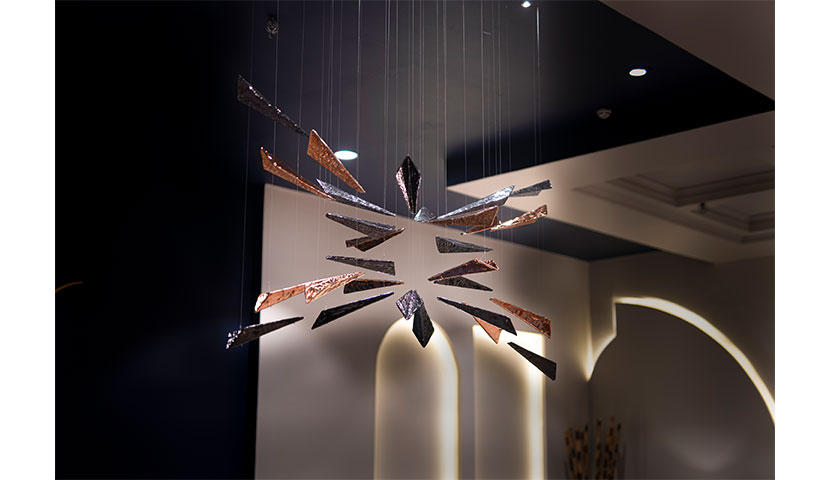
When light interacts with crystal, reflections and refractions can create something almost alive within a space.
Now imagine hundreds of handcrafted crystal pieces carefully arranged together. The chandelier is no longer simply a static object. Its appearance changes with the light and with the viewer's perspective.
During the day, natural light can move across the crystal surfaces. At night, the internal lighting gives the same chandelier a completely different character.
This ability to change is one of the most fascinating qualities of handcrafted crystal chandeliers for me.
Scale and Proportion Matter
Sometimes an exceptional design can lose its impact simply because its scale is wrong.
A chandelier that is too small for a large space can disappear within the architecture. A chandelier that is too large can overwhelm the balance of the interior.
That is why I always consider ceiling height, room dimensions, distance from the floor, furniture scale, and even the viewing angles.
Sometimes a multi-meter chandelier is exactly what a project needs. In other spaces, a more refined and delicate design creates a much stronger result.
For me, the best chandelier is not necessarily the largest one; it is the one designed specifically for that space.
A Chandelier Should Connect with the Architecture
I believe a chandelier should not compete with the architecture. It should help reveal it.
If a project has clean geometric lines, that architectural language can continue through the chandelier design.
If the architecture is defined by curves and organic forms, the chandelier can follow the same visual direction.
Sometimes, however, contrast is exactly what is needed to make the chandelier stand out.
Ultimately, the goal is to create a relationship where the chandelier and the architecture feel as though they were designed for each other.
Why Custom Chandeliers Matter
The difference between a custom chandelier and a ready-made product is that the design begins with the space itself.
For a custom project, we can determine the dimensions, form, number and arrangement of crystal pieces, lighting system, and even installation method according to the specific requirements of the project.
This gives us the freedom to create something that is not repetitive and genuinely belongs to that space.
At Light Souci, we create handcrafted and custom crystal chandeliers, and we try to give every project its own visual language.
For me, a chandelier becomes truly valuable when removing it from a space would mean losing part of that space's personality.
A Chandelier Should Be Beautiful Day and Night
A chandelier should not only be beautiful when it is illuminated.
During the day, its form, proportions, details, and crystal quality should allow it to remain an important design element within the space.
But when night arrives and the lights turn on, the story changes.
The crystals begin to sparkle, reflections move, and the same architectural element develops a different personality.
I consider these two identities very important in chandelier design:
Its personality in daylight and its personality at night.
My Perspective on Chandelier Design
After years of working in chandelier design and production, one of the most exciting moments for me is still the moment when a design moves from the screen into a real space.
Once the chandelier is installed and the lights are switched on, we can finally see whether it has truly connected with the architecture.
When it does, it is no longer just a chandelier.
It becomes part of the space.
For me, designing and producing handcrafted chandeliers at Light Souci means creating light that can complete architecture, create emotion, and ultimately shape the personality of a space.
A great chandelier does more than illuminate a space; sometimes, it gives the space its personality.
Yaser Yadegarfar
Founder & CEO, Light Souci