How Does an Abstract Idea Become a Real Chandelier?
For me, designing a unique chandelier always starts with one question: How can I turn something that doesn't exist yet into a real piece of art?
Sometimes an idea comes from a shape in nature, sometimes from an architectural line, a movement, a texture, or even an image that appears in my mind for a few seconds. At the beginning, the idea may not have a clear form, but there is something about it that makes me want to explore it and see what it can become.
I think the most exciting part of chandelier design is this journey: starting with an abstract idea and turning it into a real object that becomes part of an architectural space.
Every Design Begins with an Idea
When a new idea comes to me, I don't immediately think about how to build it. First, I try to understand the idea itself.
What feeling should the design create? Where does its inspiration come from? What role should it play in the final space? Should it express movement, follow a geometric structure, or take inspiration from organic forms found in nature? Should it become the main focal point or blend naturally into the architecture?
These questions help transform an abstract thought into a clearer design direction.
For me, it is important not to focus only on the beauty of a shape. I also need to understand how that shape can become a functional chandelier and how it will work within a real environment.
Turning an Abstract Concept into a Design
Once the initial idea becomes clearer, the next step is to give it a form that can be explored and developed.
This is where the design process begins. I work with initial sketches, proportions, and the relationship between different elements. Sometimes an idea looks beautiful in my imagination, but when I see it on paper or in a 3D model, I realize that certain details need to change.
Scale is particularly important. A design that works beautifully as a small chandelier may not have the same impact in a tall hotel lobby or a large architectural space.
That is why I always consider the environment where the chandelier will eventually be installed. Ceiling height, the dimensions of the space, architectural lines, and the viewing distance all influence the final design.
The goal is to preserve the original idea while developing it into something that works visually and practically at a real scale.
Choosing the Right Materials
Material selection is one of the most important parts of chandelier design. Materials do more than give a design its physical form; they influence its entire character.
Crystal, for example, has a special relationship with light. Its transparency, reflections, shadows, and the way individual pieces interact can completely change the visual experience of a chandelier.
Sometimes, a simple form can become extraordinary through the right choice of crystal and the way its elements are arranged. On the other hand, even a complex idea may fail to achieve its intended effect if the materials and structure are not carefully considered.
For this reason, I believe material selection should be connected to the original design concept from the beginning. Every element needs a purpose, and its relationship with light must be considered as part of the overall composition.
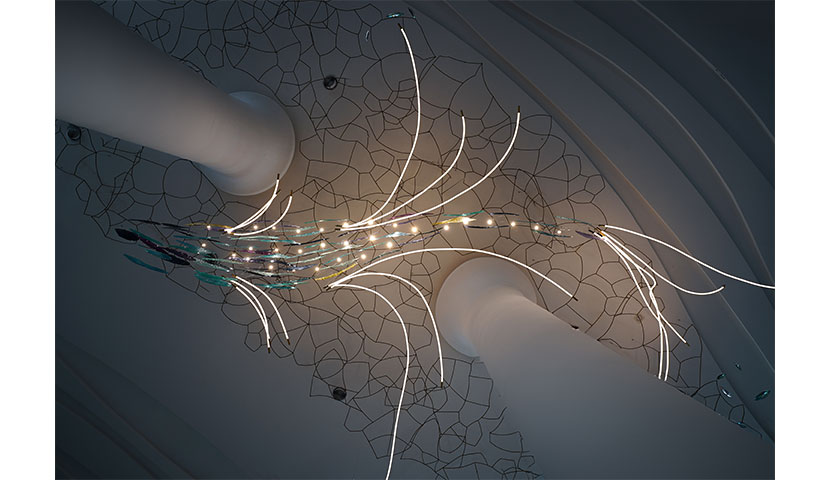 From 3D Design to Real Production
Once the form and materials have been developed, the next step is to examine the chandelier's structure in greater detail.
A 3D model helps us understand the dimensions, volume, arrangement of individual pieces, and the relationship between different components. It also provides a clearer picture of how the finished chandelier may look in its intended environment.
However, a design on a screen is never exactly the same as a physical object.
The weight of the materials, connection methods, structural stability, installation requirements, and the way light behaves in the actual environment all need to be considered during production.
Turning an idea into a finished chandelier is therefore about much more than creating an attractive design. The challenge is to find a way to build it properly without losing the identity of the original concept.
Sometimes, certain details need to be refined or different production methods need to be explored. I see these adjustments as a natural part of the creative process.
Why Handcrafted Production Matters
One of the biggest advantages of bespoke chandelier design is the freedom to develop details according to the concept and the specific requirements of each project.
When the goal is to create something distinctive, using the same formula for every space does not always work. A design may require a different arrangement of crystal elements, a particular structure, or dimensions adapted to the architecture.
With handcrafted production, attention to detail becomes especially important. Every piece needs to work in harmony with the others so that the final chandelier feels like one complete and carefully considered design.
For me, the value of a bespoke chandelier is not simply that it looks different. It is that the entire process begins with a specific idea, and every stage of design and production contributes to bringing that idea to life.
The Moment the Chandelier Enters Its Space
One of the most exciting moments comes when the finished chandelier is installed in its intended space.
Until then, we have been working with an idea, drawings, a 3D model, and individual components. Once the chandelier is installed and the lights are switched on, its real relationship with the architecture becomes clear.
This is when we can see whether the proportions work, whether the design complements the surroundings, and whether the chandelier creates the visual impact we originally intended.
A chandelier can be beautiful on its own, but its true value often becomes more apparent when it is placed in the right environment. After all, a chandelier is not just an independent object. It becomes part of the experience people have when they enter a space.
From an Abstract Idea to a Lasting Creation
For me, chandelier design is about finding a way to turn an idea into something real: an object that connects with architecture, interacts with light, and gives the surrounding space its own character.
The journey may begin with a simple thought, but bringing it to life requires creativity, an understanding of materials, careful design, and attention to the smallest details.
Ultimately, the difference between an ordinary chandelier and a distinctive design is not always its complexity or the number of components it contains. Sometimes, a simple idea, when developed thoughtfully and crafted with care, can become something visually powerful with an identity of its own.
I believe the real beauty of design emerges when the idea, materials, craftsmanship, and light come together with a shared purpose. That is how a thought becomes a real creation, and how a chandelier can become a lasting part of a space.
Yaser Yadegarfar
Founder & CEO of
Light Souci